


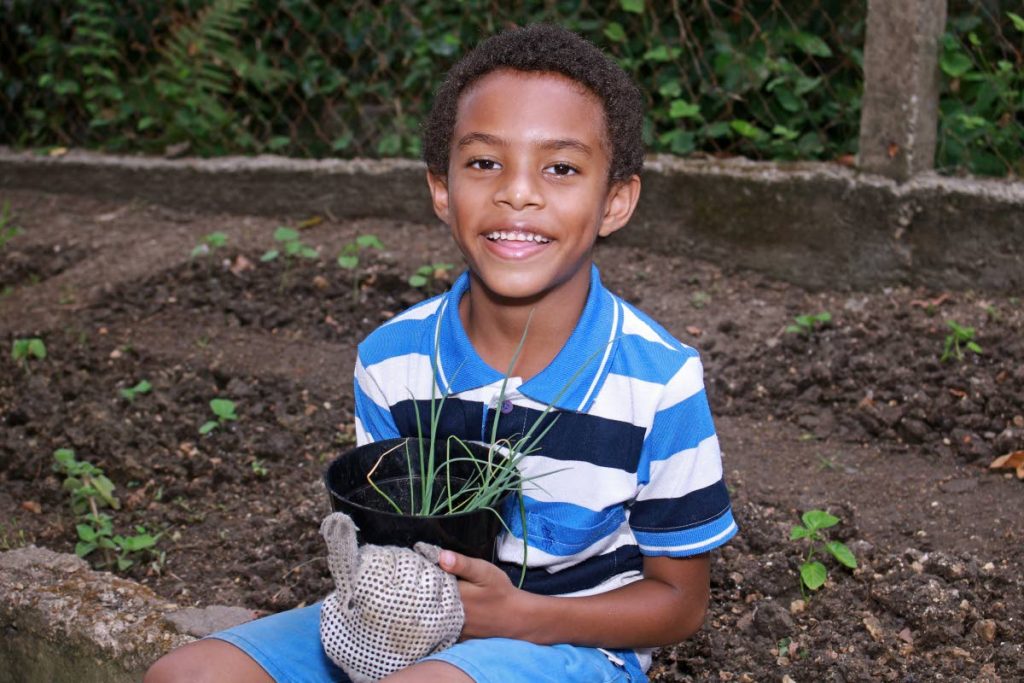
Jevon Augustus holds on to a pot of chive which he proudly planted in his home garden. File photo –
You may have noticed numerous pictures on social media of people’s newly planted gardens or produce from them.
That may be because boredom, a need to fill their time, or necessity have motivated people to start or expand their home, backyard, kitchen, or herb gardens while they are home due to the covid19 restrictions.
A St James woman said she started growing several crops in her backyard including seasonings, pimento, cabbage, cauliflower, tomato, lettuce, and patchoi for several reasons.
“Although they aren’t ready to harvest yet, it’s safer than going to the market or vegetable stalls and being around a crowd of people, I will have easier access to food, and I have something to do with all this free time I have at home.”
She added that, when the crops were ready, she would save money and growing her own food would bring her joy.
Jill Padmore had a similar experience. She said, “I have always planted. I now have the time to plant more. I planted herbs, pineapples, ginger, tumeric, pimentos and bell peppers, watermelon, chive, and tomatoes. And I’m still looking to plant more. The satisfaction you get when you get to consume what you planted is gratifying.”
Esther Pierre said she has had a herb garden for three years. This year, since she had the time, she decided to expand to cherry tomatoes, bell peppers, onions and potatoes. She said some of the seeds were on sale so her purchases, including soil and boxes, amounted to about $500.

Esther Pierre caring for her vegetable plants, interspersed with marigold flowers, in her back yard. –
“It isn’t saving me any money because nothing has grown yet but when it does I definitely won’t have to buy certain things in the grocery.”
A San Juan woman said she started planting because she had more time on her hands, and plant shops and soil suppliers had specials. She planted cucumber, bodi, tomato, cabbage, cauliflower, lettuce, patchoi, herbs, seasonings, and cannabis.
She said the soil and seeds cost her about $200 and there has been no impact on her grocery bill because they haven’t grown yet.
Another woman said she only planted one item in a flowerpot, so far, because she saw a video on the internet and wanted to try it. She said if it “worked out” she may decide to plant more.
Karen Pierre from Maraval said she had not planted anything new since covid19 landed in TT but she had green fig, sugar apple, sweet potato and beet root planters.
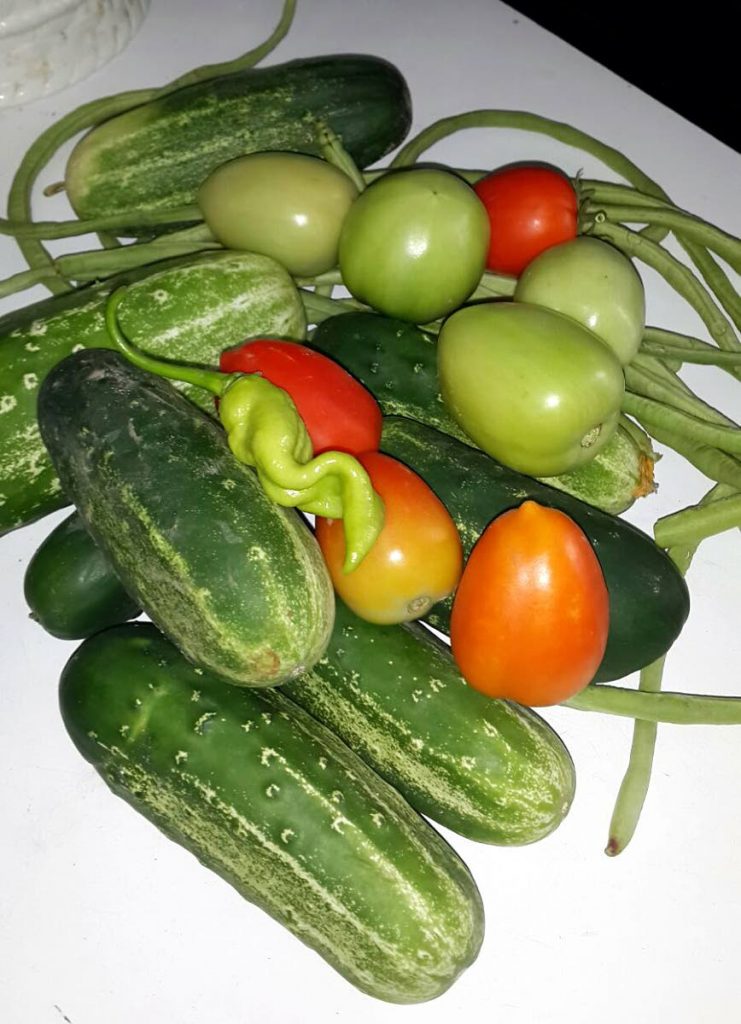
Cucumbers, tomatoes, bodi and pimentoes are among the popular vegetables people are growing at home. –
“I’m glad I had them though because this pandemic highlights the need to take personal responsibility to assist in lowering the country’s food import bill as supply chains will be further impacted moving forward.”
Plant away
Popular purchases at plant and agriculture shops were consistent with the items people said they were using.
The Aranguez Nurseries Plant Shop and Videsh’s Agri Centre Ltd in San Fernando said people were asking for seeds and seedlings of vegetable crops such as patchoi, cabbage, cauliflower, eggplant, ochro (okra), tomatoes, lettuce, cucumber, celery, parsley, chive and other seasonings. There has also been a steady demand for potting soil and complementary items, such as insecticides, pesticides and fertilisers.
Aranguez Nurseries manager Anne-Marie Rambox said many people were using planters or nursery pots to grow their crops as they did not have much land on which to plant. She said start-up could cost around $100 with a few pots, soil and some seeds or seedlings depending on the number and size of the pots. She said some seedlings would take about four weeks to begin flowering and between four to six weeks to bare depending on the care. The timeframe would be longer for those who started with seeds.
“A lot of people are trying their hands at the seeds. They like to watch it grow and see the progress themselves. They are also into organic farming so we are selling a lot of organic fertilisers even though its more expensive than the chemical-based one.”
She said people were researching the topic at home and were more aware of, and health conscious, about chemicals. She said many cannabis growers were opting for organic fertilisers as well.
Rambox added that the plant shop saw a 90 per cent increase in customers and sales compared to this time last year.
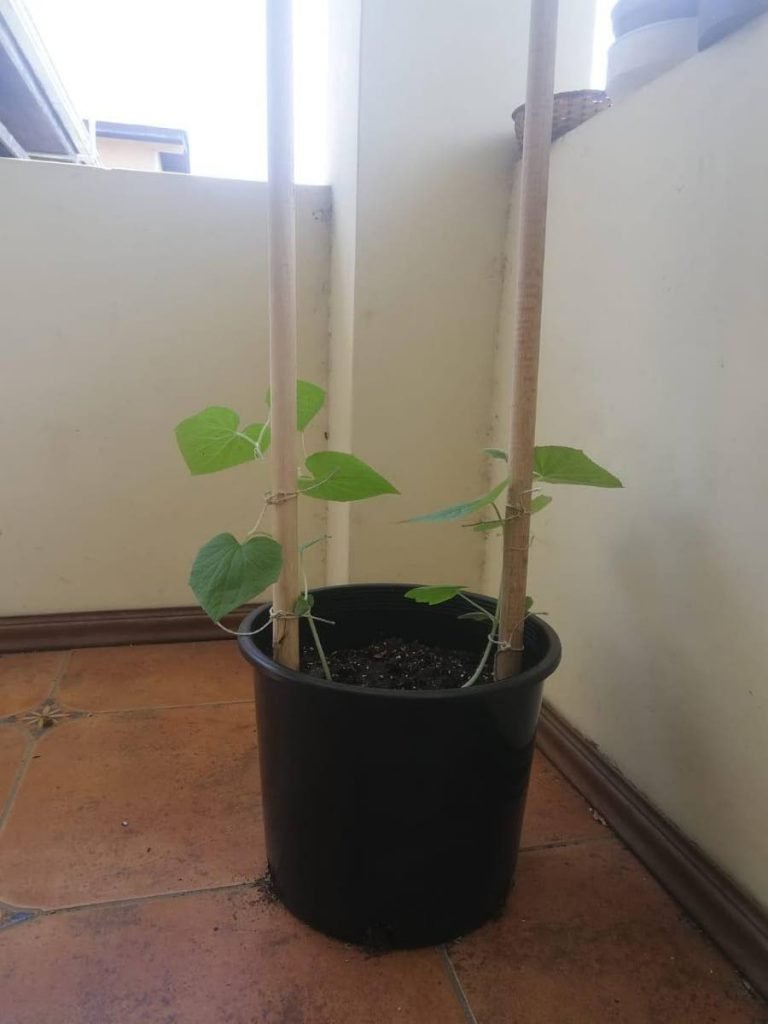
One person used a plant pot to grow her tomato plants. –
Videsh Mana, owner of Videsh’s Agri Centre, said there was also a demand for flowering and ornamental plants as people took on projects to beautify their homes and gardens.
He said he noticed a lot of new customers since the country went “on lockdown” about two months ago but whether they were new to gardening, or new to his shop, his staff would explain the process from planting to reaping and recommended purchases.
He said he usually had a high demand for flowering plants between Valentine’s Day and Mother’s Day so there was no significant increase in the number of sales so far. The fact that he had a lot of wholesale business also contributed to the stability of his numbers.
However, he said the items people bought were different because they were now purchasing vegetable plants.
Director of the Agricultural Services Division, Ministry of Agriculture, Allan Balfour, said his division was seeing similar demand from the public but the ministry did not sell items such as tomatoes, green peppers, lettuce, and patchoi.
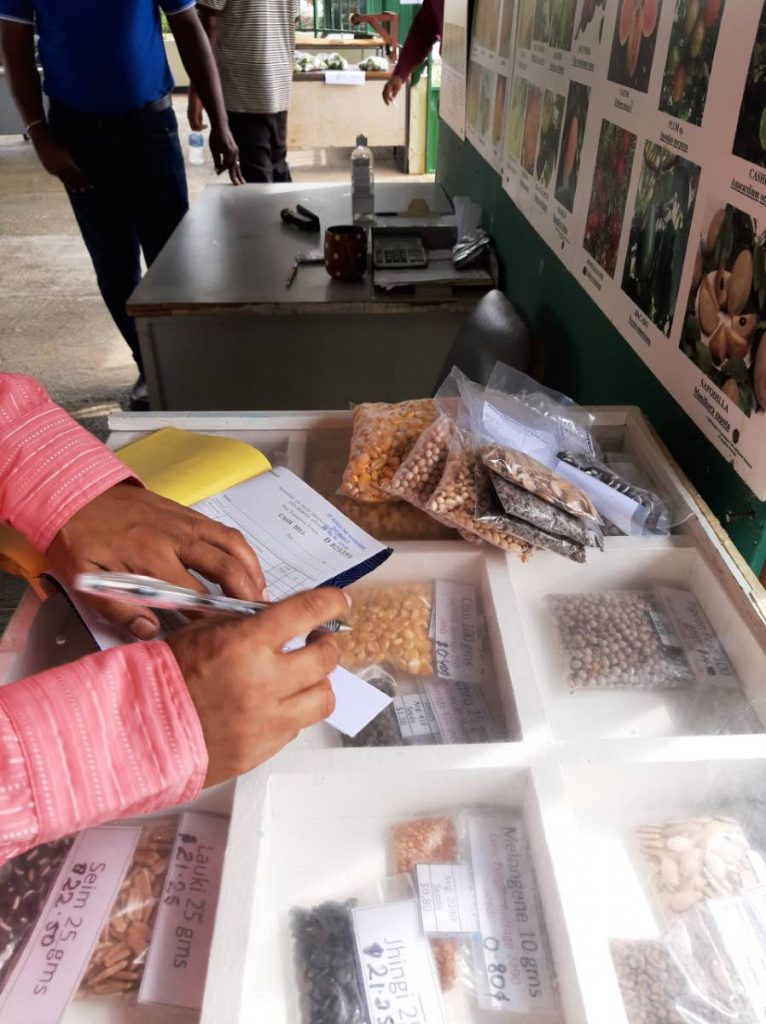
An Agricultural Services Division employee handles the sale of vegetable seeds at the division’s St Augustine Nursery. –
“Those are hybrids. Every time you have to plant them you have to buy a new batch, whereas the ones we have for sale are local open-pollinated varieties. You can take the seeds from that tree and re-plant them. We leave the hybrids for the commercial people. We don’t want to compete with them because our prices are subsidised and therefore cheaper than the open market.”
He said the “big sellers” were fruit trees such as mango, avocado, and citrus. He said most people’s backyards seemed to have room for a dwarf mango tree, or miniature pommecythere that could fit in a big pot.
He said vegetable seeds and seedlings such as eggplant, bodi, hot peppers, corn, pigeon peas, pumpkin, and caraili were also popular. He added that, because of the demand for vegetable seedlings, the division would make them available on a more consistent basis from June but with limited distribution.
“Because of the increase in demand we have to restrict the number of certain big sellers to each customer so that our supply can stretch a bit.”
Balfour explained that the division sold seeds from the National Seed Bank in Chaguaramas at the St Augustine Nursery and La Reunion Plant Propagation Station in Centeno. They also sell original and grafted fruit trees, as well as vegetable and ornamental plants.
He said, usually, their biggest sale period was the second week of June, around Corpus Christi, and it remained so even with this year’s spike in sales due to covid19 and the first distribution of seeds at the launch of the national seed initiative, Grow Trinbago, in Arima on May 9.
The initiative meant the distribution of over 50,000 seeds through MPs and local government representatives to households in various communities to encourage people to get more involved in home-gardening.
“That in itself brought a lot of attention to the fact that we have seeds. So even though people were getting them for free through the initiative, there were those who came to purchase seeds.”
He said there was a 20 per cent increase in plant sales at La Reunion compared to May 2019. In St Augustine, there was a 16 per cent increase in income from sales and a 30 per cent increase in seed purchases.
With so many new gardeners in TT, Balfour gave some tips.
He suggested that people alternate the harvest stages by staggering their planting. In this way they would not have a glut of produce that they could not use and therefore lead to wastage.
“Stagger the planting. Use a third of it now, wait a month or six weeks to plant another set, and another six weeks to plant the rest. Then you can get a continuous supply of the produce in volumes that you can manage and eat.”
Intercropping, he said, was another good idea. He suggested that people plant multiple crops in the same space so at harvest time, people would get a little of everything to satisfy their dietary needs instead of large amounts of a few items. He said this also helped limit the movement of pests and diseases between crops.
He added that some people plant marigold and chrysanthemum flower beds between crops as they had pesticidal properties.
May 30, 2020:- The Public is kindly advised that in accordance with Regulations 2 (3) of the Conservation of Wild Life Regulations made under Section 24 of the Conservation of Wild Life Act, Chapter 67:01, Submission of Mandatory Data Forms for the 2019-20 Hunting Season becomes due on or before 31st May, 2020.
However, due to the current ‘Stay at Home Measures’ this would have affected the Forestry Division’s normal business operation hours and as such, restricted hunters from submitting their Data Forms in a timely manner. In this regard, the Honourable Minister of Agriculture, Land and Fisheries has amended the regulations to extend the original deadline from the 31st May, 2020 to Friday 31st July, 2020.
The Forestry Division is therefore reminding persons who are in receipt of the Mandatory Data Forms to please visit any of its locations and submit their forms in the available Collection Boxes.
The Ministry of Agriculture, Land and Fisheries (MALF), thanks you for your support and look forward to continue serving you.
Denny Dipchansingh
Conservator of Forests


May 26, 2020:- The Grow Trinbago Seed Initiative distribution continued last Thursday 21st May, as Senator Avinash Singh, Parliamentary Secretary in the Ministry of Agriculture, Land and Fisheries (MALF) presented over five hundred (500) packets of seeds to Mr Esmond Forde, Member of Parliament for Tunapuna.
The small event took place at Paradise Heights, Tacarigua, also included resident of the area and their Local Government Councillor. In his brief remarks, Senator Singh urged residents to take advantage of the programme which encourages persons to get more involved into home gardening and “Plant Something.” Both residents and the MP for the area lauded the national initiative and gave their assurance and commitment to making the programme an overwhelming success.
On the following day, Friday, 22nd May, the Minister of Agriculture, Land and Fisheries – Clarence Rambharat presented Colm Imbert, Minister of Finance and the MP for the Diego Martin North/East Constituency with seeds for the community.
The Grow Trinbago Seed Initiative was officially launched on 9th May by the Agriculture Minister with the intent of distributing over fifty thousand (50,000) packets to the national community.
Persons who are interested in obtaining seeds must first contact either the Office of the MP or the Local Government Councillor in their area in order to register for collection of the seeds.

RADHICA DE SILVA
radhica.sookraj@guardian.co.tt
T&T’s forests are being bulldozed by unscrupulous quarry operators, miners, slash-and-burn farmers, and squatters and the State seems powerless to stop it.
With the Forestry Division severely understaffed, deforestation has now reached crisis levels and had escalated even more since the lockdown of COVID-19.
Many foresters are afraid to stand up against the armed criminals who chop down the valuable forests for wood, fertile soil or various types of quarried material.
During an interview with Guardian Media, Conservator of Forests Denny Dipchansingh revealed that the Public Service Commission needs to fill over sixty vacancies of Foresters and approximately 40 game wardens.
“More staff obviously will have increased manpower to curb these illicit activities. However, the present staff must be commended for their efforts,” Dipchansingh said.
As public officers, he said foresters are bounded by an 8 am to 4.15 pm workday and they are not entitled to overtime nor additional allowances.
He also said there has been an increase in deforestation.
Earlier this month when forestry officers returned to work after the COVID-19 lockdown, they discovered that 25 hectares of the Ecclesville Windbelt Reserve in Rio Claro were ploughed down by rogue farmers to plant crops.
Dipchansingh explained that the wind belt reserve in Rio Claro, which comprises a total of 515 hectares, was designated to protect surrounding communities against storms and hurricanes. Over the years, however, approximately 150 hectares have been bulldozed by illegal farmers.
There has also been the destruction of 300 hectares of forests reserve in Tableland within recent times.
Asked what is being done to curb the rampant increase in deforestation, Dipchansingh said, “We have increased patrols outside of the normal working hours to prevent further encroachment and have gotten assistance from the TTPS on patrols. We would be liaising with the Land Management Division and a more vigorous approach will be implemented with the Commissioner of State Lands to evict these illegal squatters.”
With regard to encroachment by farmers on the nation’s forests, Dipchansingh said they have started educating farmers on the dangers of cutting down the forest’s trees.
“A plan of action will be implemented using a participatory approach with the farmers, with respect to enforcement and education,” he added.
Saying there were 36 forest reserves in T&T with a total area of 119,056.82 hectares, Dipchansingh said, “By standard international criteria, T&T has about 48 per cent forest cover.”
However, he said several areas islandwide have been destroyed based on post-independence comparisons of forest cover maps.
He said the Forestry Division focuses its efforts on the protection of the Forest Reserves.
“It should be noted that not all the areas are totally cleared of forest cover as secondary forests have grown over abandoned squatted lands and Forestry Division has replanted some of these areas over the years. Our work programme entails replanting at least 100 hectares per year,” he added.
He noted that forest officers had no authority to evict illegal squatters.
“Forest officers are empowered under the Forests, Sawmills and Conservation of Wildlife Acts. The Conservator of Forests does not have the authority to evict illegal occupants or squatters. Presently this Authority lies only with the Commissioner of State Lands,” he said.
He added, “ Our charges relate only to the above-stated Acts and offenders in these cases can only be charged for illegally cutting trees. Over the years several individuals have been fined varying $5000 -$25000 for illegal cutting. In the most recent case, an individual was bought before the Courts for illegally cutting in the Matura Forest Reserve and was given a one year bond to keep the peace.”
Kristopher Rattansingh, chairman of the Wildlife and Environmental Protection of Trinidad and Tobago (WEPTT) earlier this month appealed to the authorities to equip the Forestry Division with the necessary resources to save the forests and wildlife.
Based on a report published by mongabay.com, T&T has some 678 known species of amphibians, birds, mammals and reptiles according to figures from the World Conservation Monitoring Centre. Of these, 2.2 per cent are endemic, meaning they exist in no other country, and 2.5 per cent are threatened. T&T is home to at least 2259 species of vascular plants, of which 10.4 per cent are endemic.
The various forest land classification in T&T are:
Natural Forests
Forest Plantations
Other Wooded Lands
Grasslands
Forest Wetlands

18 May 2020, Rome – The UN’s Food and Agriculture Organization (FAO) is seeking $350 million to scale up hunger-fighting and livelihoods-boosting activities in food crisis contexts where COVID-19’s impact could be devastating.
Although the pandemic’s full-scale and long-term impact on food security is yet to be revealed, evidence shows that in countries already hit by acute hunger, people are increasingly struggling to have access to food as incomes fall and food prices rise.
If farmers do not have access to their fields, or do not have the means or access to buy seeds and other inputs to plant or buy feed for their animals, planting seasons will be missed, cultivation will drop significantly and animals will be lost. This means that less food will become available too – in both rural and urban areas.
“We cannot wait until we finish dealing with the health impacts before we turn to food security. If we don’t start implementing livelihoods assistance now, we will face multiple food crises. And a bill many times greater,” warned FAO Director-General QU Dongyu at a briefing today on the UN agency’s revised humanitarian response to COVID-19.
“It’s becoming increasingly clear that the pandemic’s impacts go far beyond health,” said Ramesh Rajasingham, Acting Assistant Secretary-General for Humanitarian Affairs and Deputy Emergency Relief Coordinator.
“Acting early can prevent increasing vulnerabilities but also be a much more cost effective way of addressing this crisis. The role of emergency livelihoods interventions to save lives and livelihoods, and pull back people from the verge of famine is critical. Agriculture-based livelihoods are critical in most countries we work in as they are the main source of income for the majority of vulnerable populations. And this relies on seasons that cannot be missed or skipped,” added Rajasingham.
“More and more global leaders are stressing that the pandemic could cost more lives in hunger than in those actually infected by the virus. The worst-case scenario is not a foregone conclusion, but we have to act fast – and at scale,” said Dominique Burgeon, FAO’s Director of Emergencies.
New funding request to respond to growing needs
FAO’s new funding request of $350 million is about three times more than in late March as COVID-19’s staggering socioeconomic impacts become more evident.
FAO’s humanitarian response to COVID-19 is part of the Global COVID-19 Humanitarian Response Plan.
Additional funding is urgently required to address new needs emerging from COVID-19. New activities will build upon critical livelihood-saving support currently being delivered, including:
Overall, FAO’s humanitarian response to COVID-19 impacts will focus on: improving hunger data collection and analysis so that organisations can respond more effectively; maintaining food production, including through scaling up activities so that farmers can take advantage of coming plating seasons; ramping up support to post-production activities, like harvesting, storage, small-scale food processing and conservation, and linking producers to markets to ensure food supply chains stay functional; and, awareness raising so that people keeping food supply chains alive are not at risk of COVID-19 transmission.
Facts and figures on hunger and pandemic’s impact on food security[1]:
While there is a high potential for a significant rise in acute food insecurity at crisis level and above in the coming months, this is not inevitable.
“If we support livelihoods now we can help to reduce needs and avoid growing hunger. And protect the most vulnerable from the collateral effects of the pandemic,” said Qu.
“Donors were generous and fast in responding to the desert locust upsurge during the past months. We need this continued generosity and advocacy to prevent a steep rise in acute hunger. Thank you for your action now,” added the FAO-Director-General.

Minister of Trade and Industry Paula Gopee-Scoon said the development of the agricultural sector is part of the country’s post-COVID-19 recovery plan, along with the manufacturing sector.
Speaking at Monday’s media briefing on COVID-19, Gopee-Scoon said that the volatility of the energy sector has shown the need for development into the manufacturing industry, as well as the agricultural industry.
“Given the volatility on the energy side of things…we have to look at which sectors are best for the growth of the economy. The manufacturing sector…is the way to go. The expansion of the manufacturing sector is one we’re looking at.
“The agricultural sector is definitely an area of focus. Whilst we may not have been contributing considerably to the economy, it’s a sector which we have been working on. The Minister of Agriculture, Land and Fisheries has been focusing on the sector and playing a key role in bringing the agricultural product to the population (during COVID-19). It’s the way we are going and that’s going to be key as well.”
“If I had to focus on any industries, yes the relevance on energy, yes the manufacturing industry and a greater focus on agricultural industries.”
Gopee-Scoon did refer to certain issues such as in US-based meat-packing plants, but said there have been no issues to date locally. She said that there is no shortage in the import of food and other items as Finance Minister Colm Imbert assured that there would be sufficient foreign exchange for this purpose.
Gopee-Scoon: Minor price increases for some food items
She also referred to the fluctuation of global food prices, she said that currently, the country has no issues with the supply of food imports.
She said they are aware of the price of supplies and said they have been conducting a risk analysis by product and monitoring the situation.
“Some members of the private sector have had to look at alternative supply chains and therein we would have had some minor price increases. For instance, there would have been a challenge with grains (and beans). Many importers went to an alternative supplier, and therefore that caused the price of some bean items to go up. So those are the kind of challenges we’ve had.”
She said the Ministry continues to analyse these products in their efforts to ensure food security.
She also urged the public to become involved in a local seed growing campaign courtesy being launched by the Ministry of Agriculture, Land and Fisheries.
The Ministry launched the GrowTrinbago Seed Initiative in which over 50,000 seeds will be distributed to households across the country, featuring seeds from the country’s seed bank.
Some of the seeds being given include local crops such as pigeon peas, melongene, bodi, corn, pumpkin and ochro.
Several organisations have launched local kitchen garden kits which will allow homeowners to grow their own crops at home.
The distribution will be coordinated through MPs and local councillors.
For more information contact the Ministry on 220-6253
Read the original article here


Selection and Preparation of Containers,
Preparation of the Growing Medium and Land Preparation
Identification and Selection of Appropriate Containers for Planting Crops
Some Guidelines when choosing your container are:
Video – Selection and Preparation of Containers
https://www.facebook.com/103936031246037/videos/vb.103936031246037/898393213953008/?type=2&theater
Information courtesy the Extension Training and Information Services (ETIS) Division
Ministry of Agriculture, Land and Fisheries


