


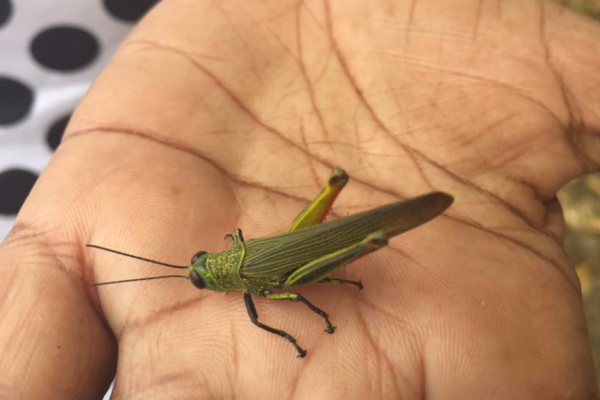
Management of the Moruga Grasshoppers/Locusts
The Ministry of Agriculture and Fisheries (MALF) continues to be very vigilant in its ongoing efforts to control the Moruga Grasshoppers (MG)/Moruga Locusts. The MALF recognizes the distress of affected residents and regularly advises farmers on control methods to minimize damage to crops on their holdings. Traditionally, the Moruga Grasshopper has a one (1) year life cycle and the Ministry has customarily engaged in management activities at each stage of its cycle. Over the years, the MALF has adopted a participatory approach as part of its control strategy, by engaging key stakeholders in the surveillance aspect of the pest control programme.
Stakeholders are instrumental in working with the MALF as they are required to track the flight path of the locusts and locate their eggs. The Ministry will then effect chemical controls on the immature grasshoppers when they emerge from the eggs. This aspect of the control strategy is currently being implemented. Targeted spraying of immature MG is also done along the perimeter of the infested forests. Aerial spraying is NOT conducted when adult locusts are in flight because of the possible negative effects on human health, wild life, beneficial insects, the environment (water courses and aquatic life) and possible contamination of sundried cocoa. It should be noted that locust swarms are a global phenomenon. While there are multiple species of locusts identified, countries have not been able to successfully eradicate these pests.
Trinidad and Tobago have experienced more frequent and severe infestations in recent times. Historically, outbreaks of the MG were initially reported every 14 years, but its occurrence is now annually, with locusts having the ability to change their behaviour and migrate over long distances. This change may be attributed to climate change and other factors inclusive of changes in temperature as well as, torrential rain both of which provide the ideal environment for breeding.
The Ministry is cognizant of the current threat posed by the Moruga Grasshoppers (MG) at this stage of their life cycle and our Officers will continue to provide the necessary support to the national community in a collective and meaningful way.
END


